
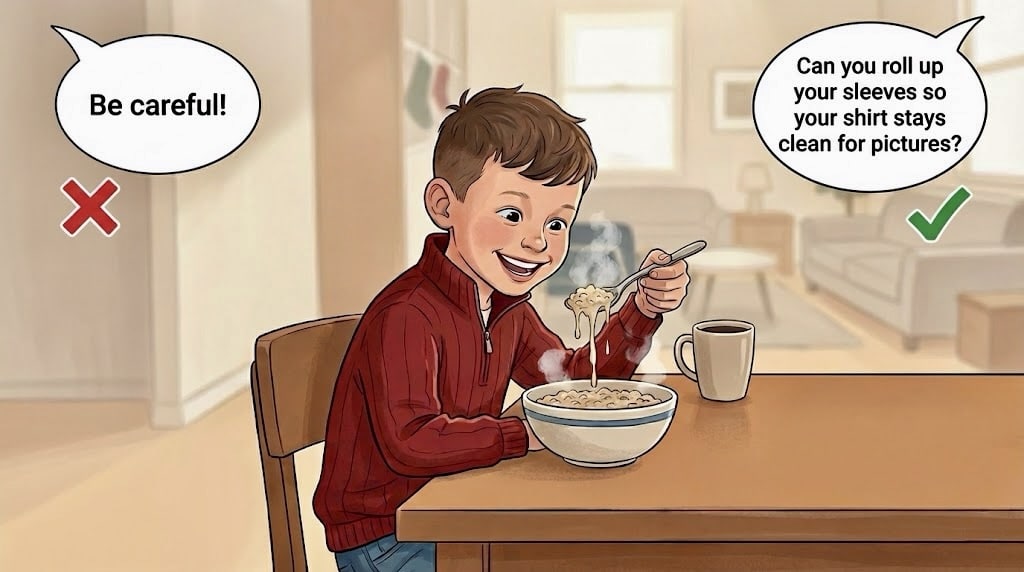
Today is picture day at my son’s school. He sat down to breakfast in his gorgeous new red quarter-zip sweater. As I brought him his oatmeal, I asked him to roll up his sleeves. He refused, and continued watching his tablet.
I tried to explain why it was important. He still refused. My wife tried. He said no to her too. We decided to let go and let him live with the consequences.
I’ve noticed a pang of frustration in me when I talk to him in the old way before I notice that he’s improved his communication skills. Maybe because he feels condescended to.
A couple years ago, I remember the delight as we went from single words to sentences to him expressing what he wanted, advocating for how he felt. Amazing transition. I needed to remember to adjust my communication style as he upgraded his.
This morning’s interaction reminded me of what I’ve learned this year working with AI products. Your AI started this year far less capable than it is now. Did your communication style grow up with it?
2025 has been an arms race that moved us from creating one-off parlor tricks to enduring, life-changing magic. Image generation went from six fingers and misspelled words to photorealistic output in under twelve months. Our tools grew up fast.
And if you talk to your AI as if it’s still an infant when it’s capable of sophisticated work, you’re missing out. If you’re using old techniques you learned interacting with earlier models, you might be okay—but you’re not getting results as good as they could be.
I’ll give you one example. All year, I’ve been advising friends and clients: when a conversation gets too long and the AI gets dumb, stop, ask it to generate a continuation prompt, start fresh in a new chat. Necessary but annoying.
A few weeks ago, Claude released automatic compacting during chats. Imagine a chat’s memory is the size of an aluminum can. When you crush the can down, the important information is still accessible, but compressed to free up memory and lift performance. I’ve had conversations compact 2-3 times without Claude getting dumber. When going from draft to polish, my previous start-stop-restart workaround is less necessary, especially when Claude and others have added conversation memory.
This is just one example of a smart feature that forced me to change how I use these tools. If you’re interacting with gen-AI ad-hoc, and especially if you’re like me and have dozens of agents, projects, and gems that were built earlier in the year—you need to evolve how you speak with them so you can get the most out of them.
My wife and I walked away from our son as he dove into his oatmeal. We looked back as he started rolling up his sleeves. He understood the advice we were giving him. He just wanted to make the decision himself, on his own time.
December’s a good time to ask yourself: Am I still talking to AI as if it were a child?